← Back to portfolio

SCARA diploma project / completed 2026

SCARA ×
industrial control.

A low-cost educational robot built across every layer: bearings and printed links at the bottom, motion firmware in the middle, and an industrial communication contract with a Siemens PLC at the top.

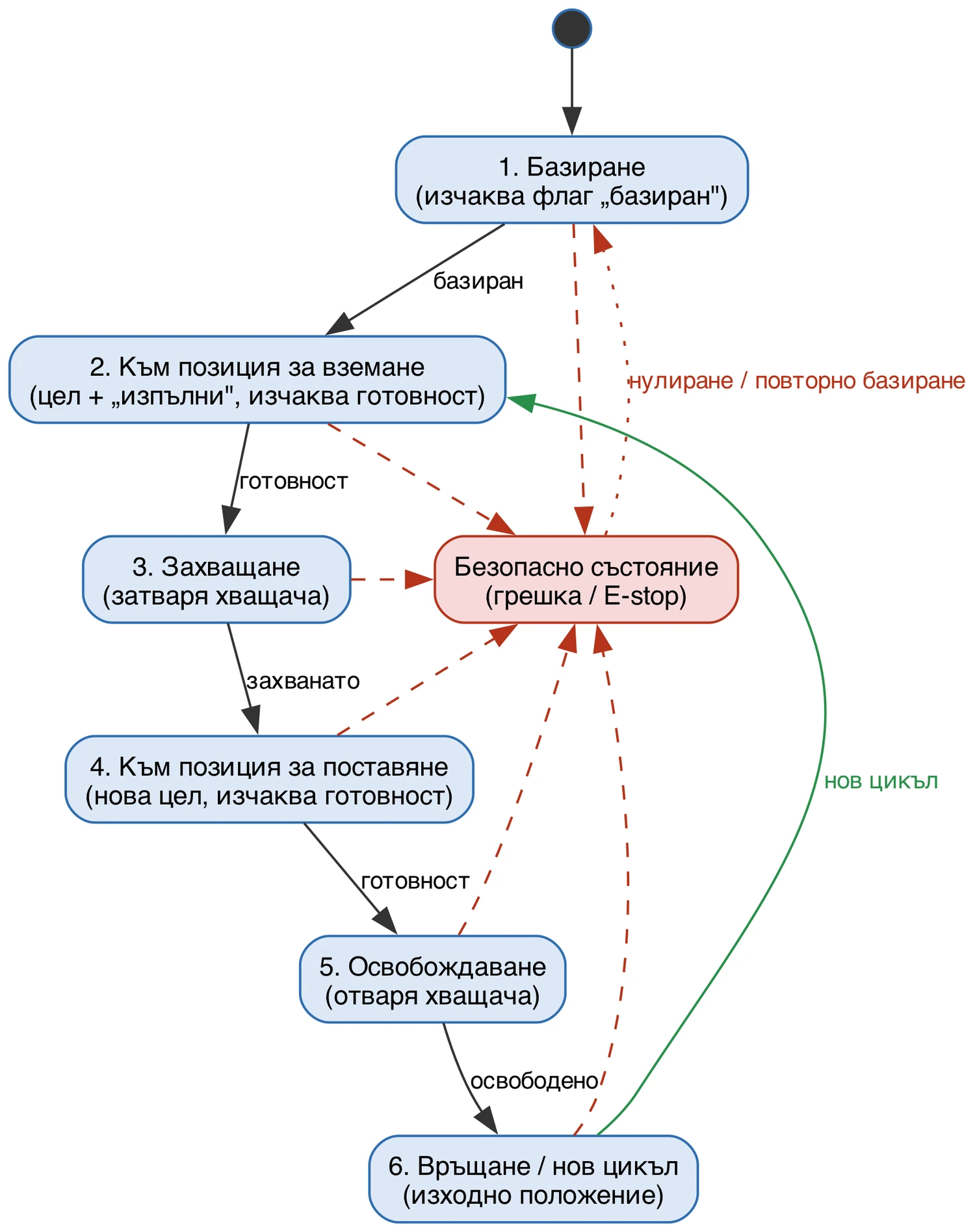
DR-2026 / PICK-AND-PLACE CYCLE
3 + 1SCARA axes + gripper
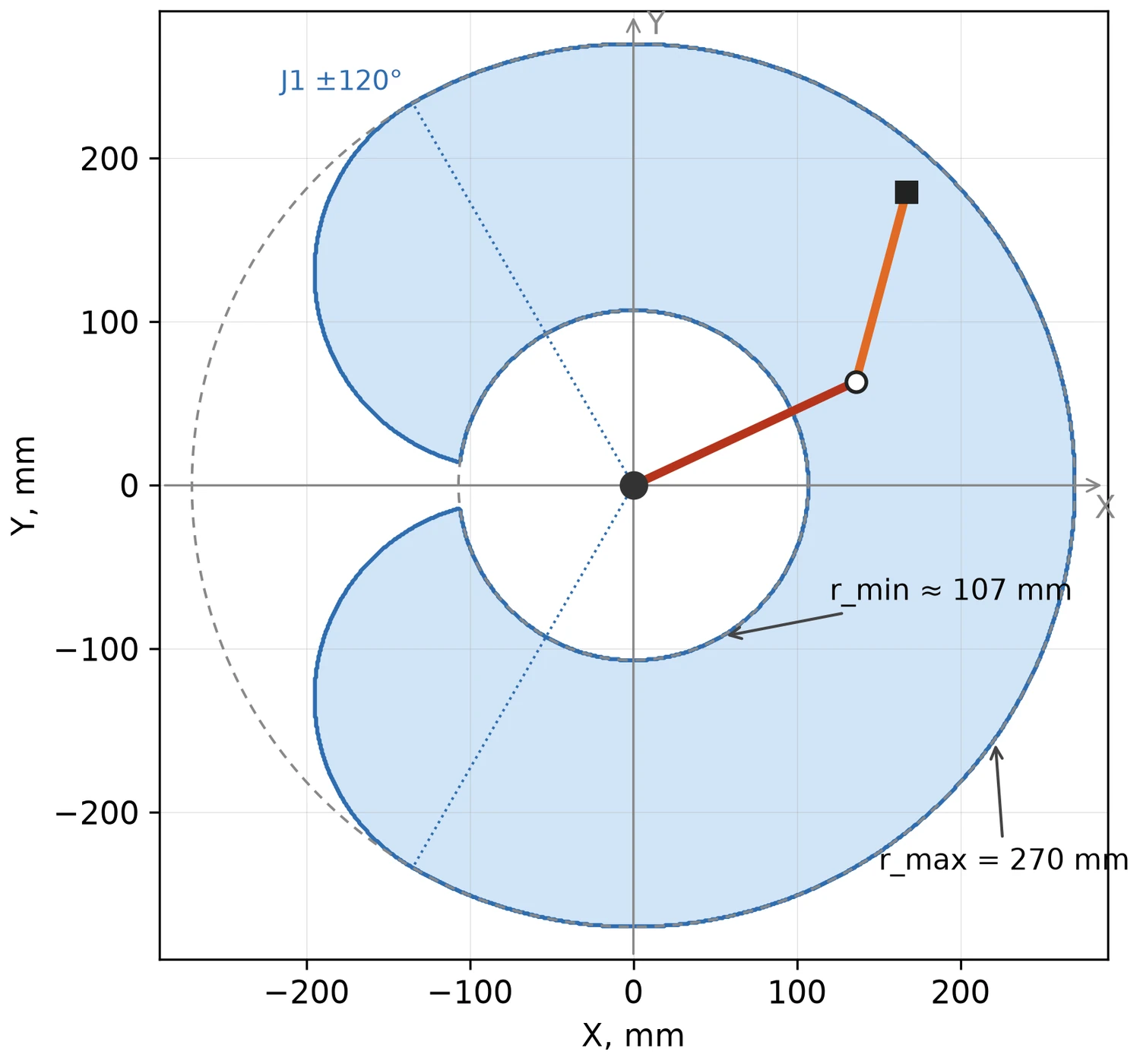
270 mmCalculated maximum reach
230 gPayload physically lifted
€232Estimated platform BOM

Project brief

An open, repairable training platform.

Industrial training robots are capable and reliable, and almost always out of reach for a student. This project asks whether the same architectural ideas can be learned on a machine that is affordable, open and repairable.

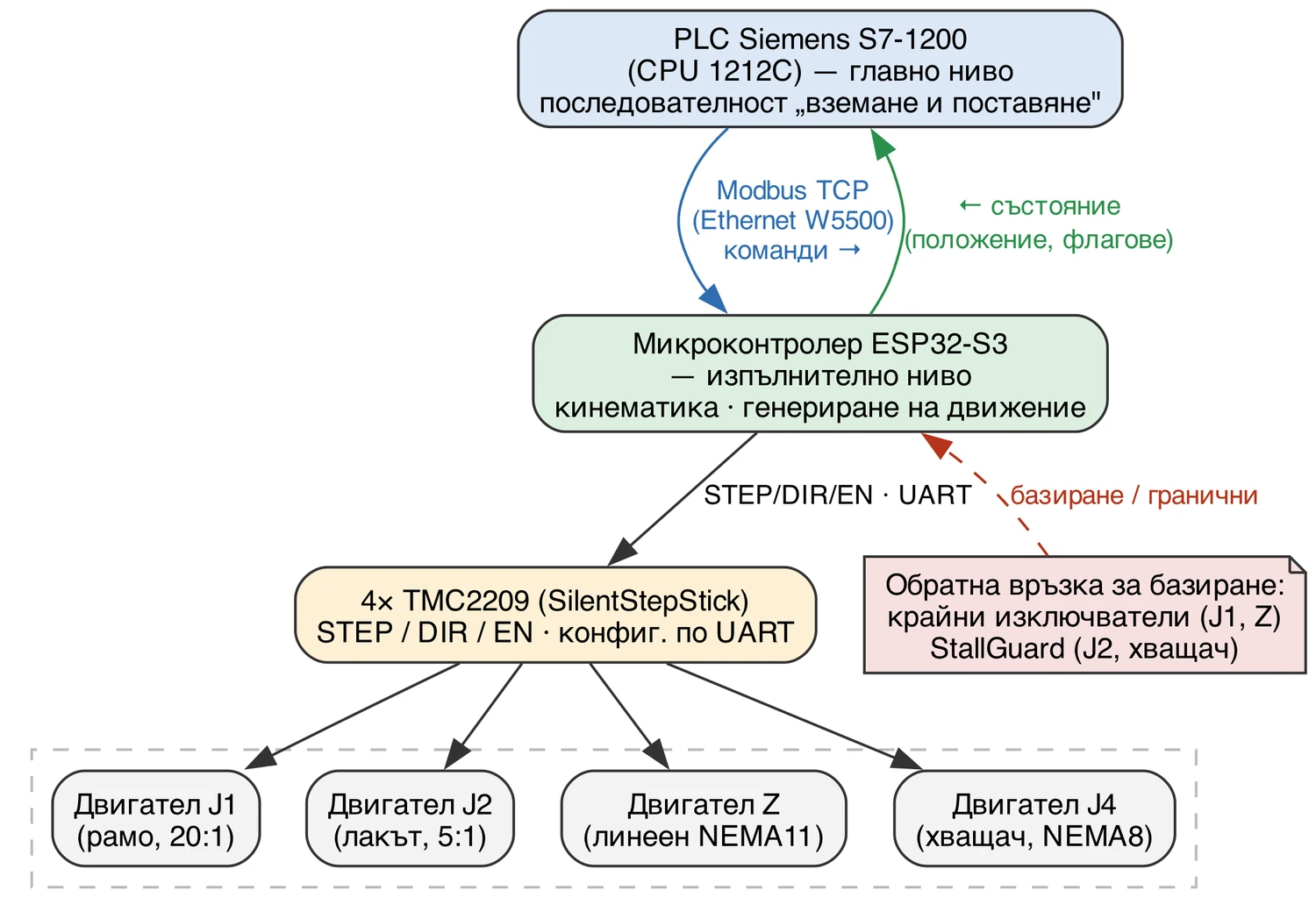
The answer is a three-axis SCARA manipulator with a motorized gripper. The PLC owns process intent; the ESP32 owns kinematics and motion. Modbus TCP is the explicit contract between them. The machine can also operate independently through its embedded web interface.

The goal was never to imitate industrial certification. It was to leave the whole chain exposed, from bearing preload to PLC register, so every decision can be inspected and argued with.

Design evolution

From UMX v0.1 to a ground-up redesign.

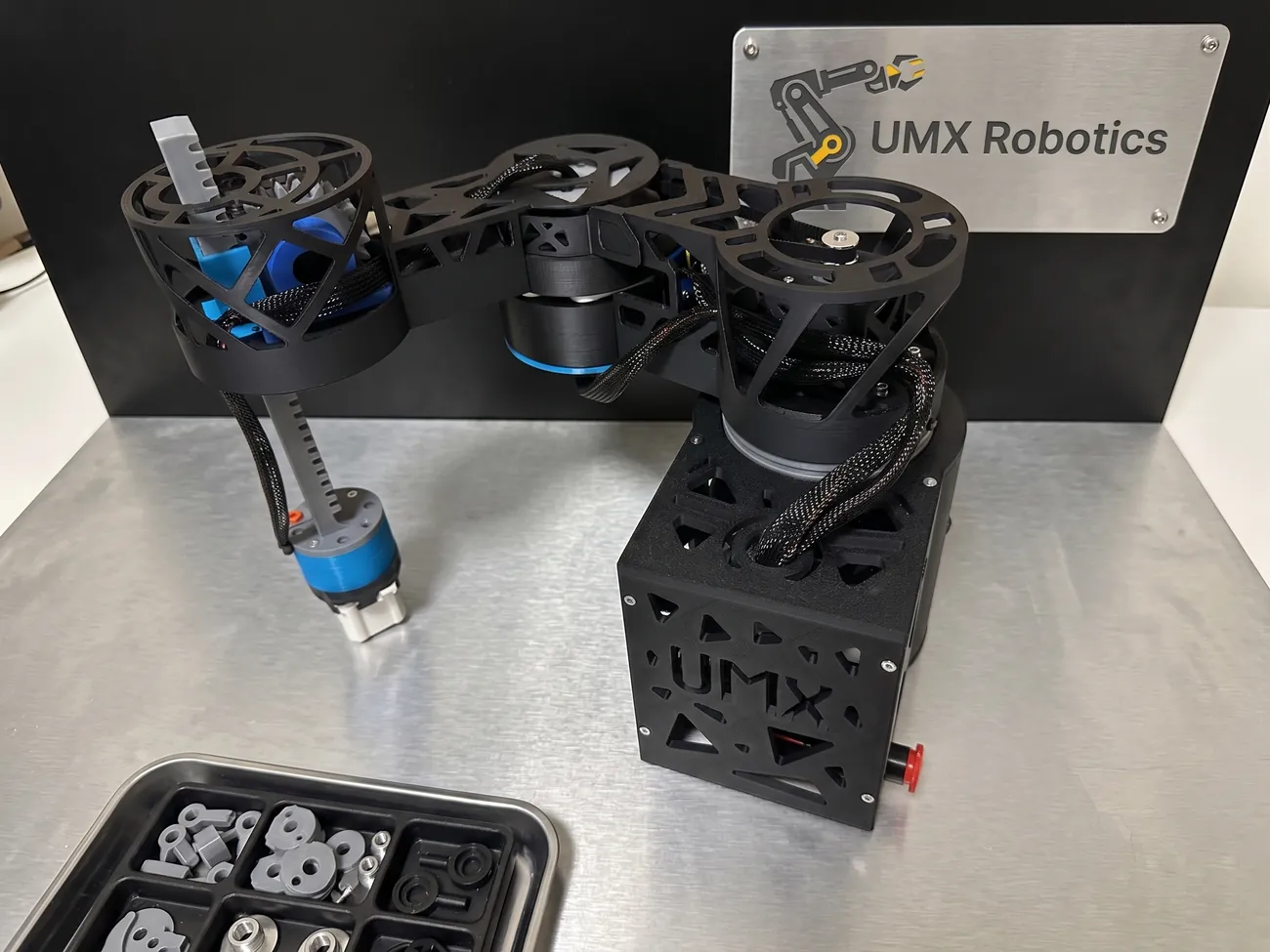
UMX v0.1 proved the educational idea. The diploma became a complete redesign: different structure, transmissions, Z-axis, gripper, electronics and control architecture.

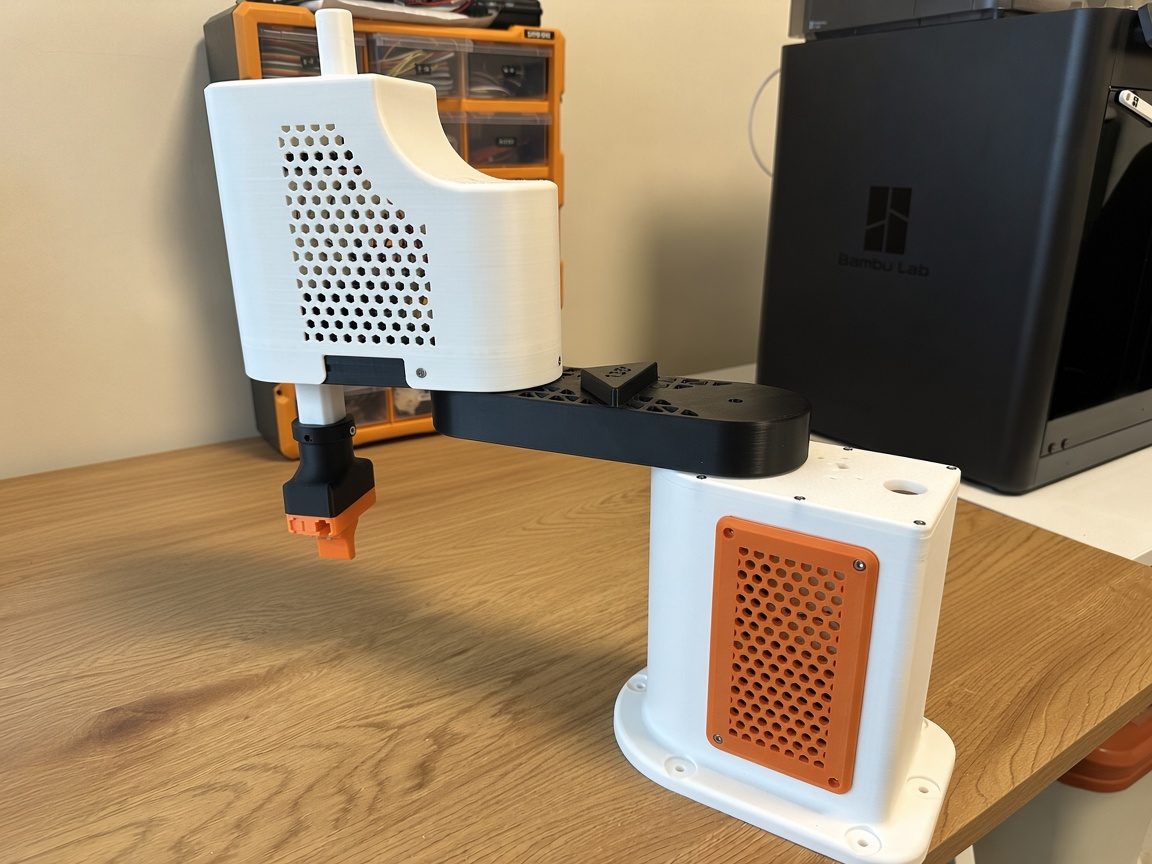
Earlier UMX v0.1 robot prototype

Generation 01 · UMX concept

Initial prototype

Planetary and belt drives, a rack-and-pinion Z-axis and Wi-Fi control established the concept. They also exposed the structural play, the serviceability problems and the motion-control ceiling that the redesign had to fix.
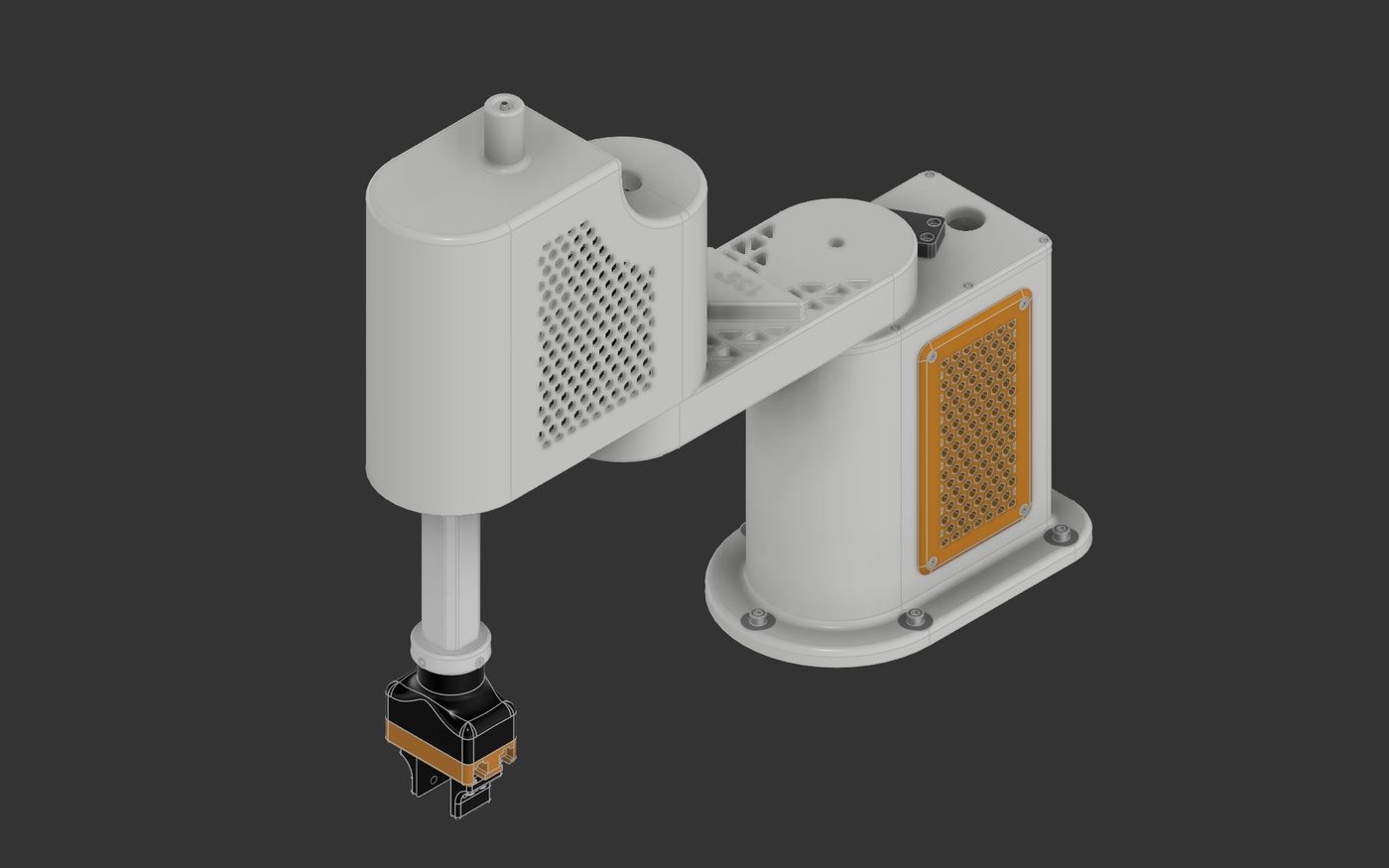
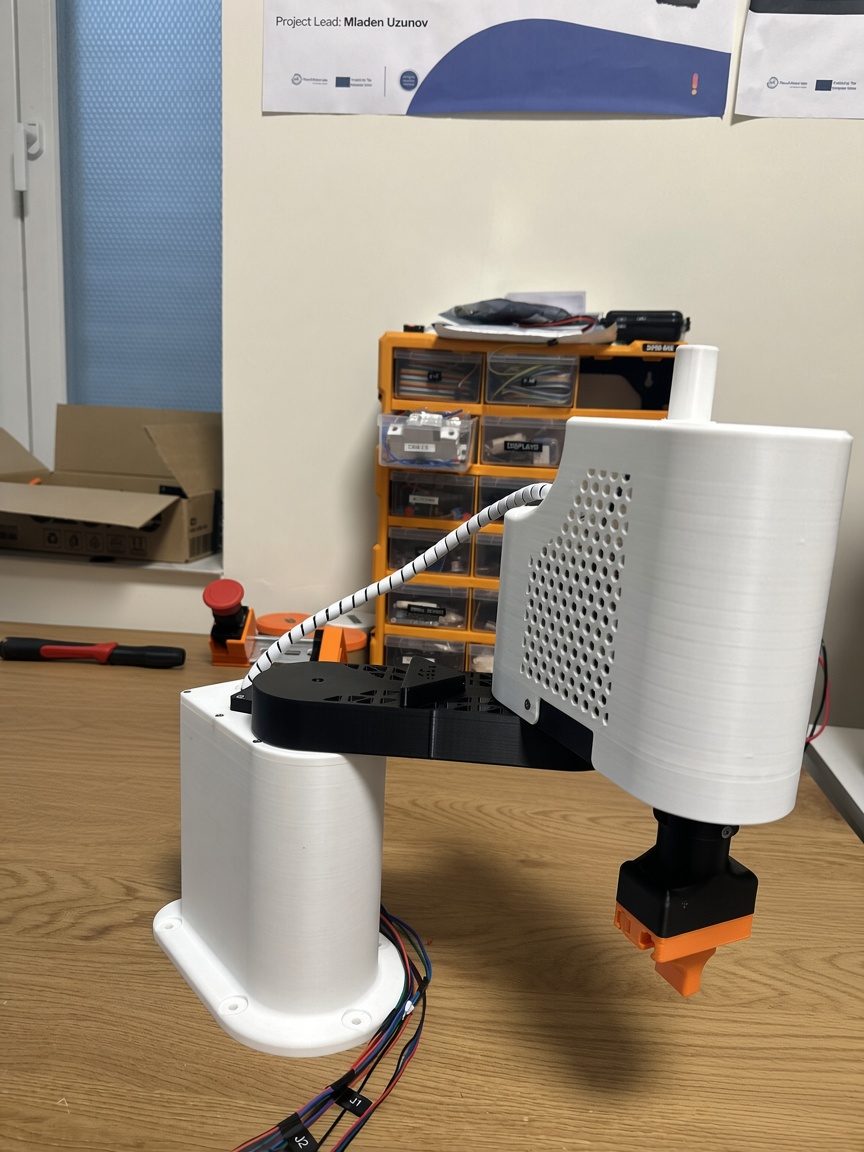
Fusion 360 assembly of the final diploma SCARA

Generation 02 · Diploma

Diploma redesign

New geometry drawn in Fusion 360, steel bearing arrangements, an ACME Z-axis, four stepper drives, ESP32 firmware, a web UI and a Siemens-oriented Modbus TCP architecture.

Control architecture

PLC supervision and embedded motion control.

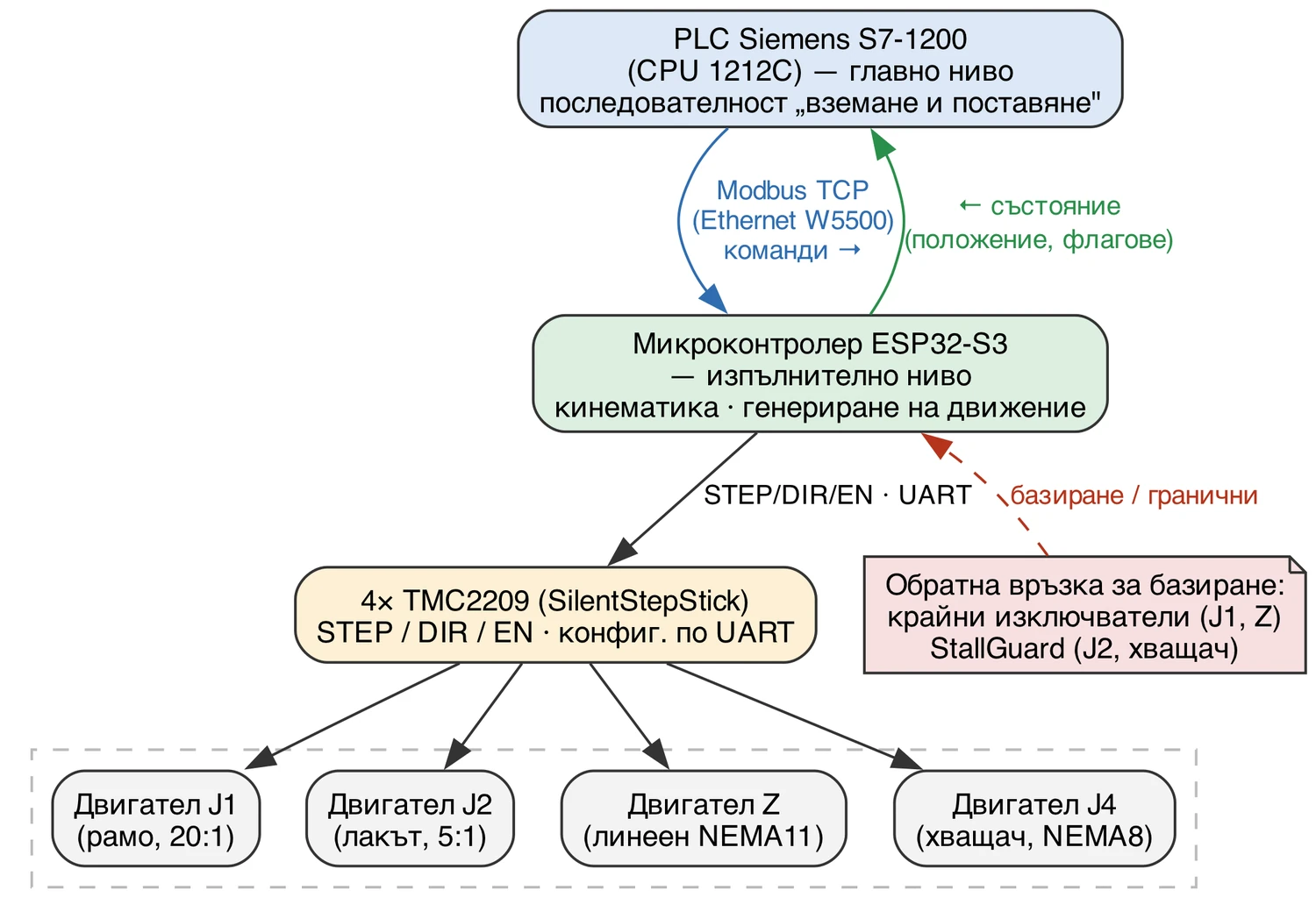
The system is deliberately split at the point where industrial sequencing and real-time motion have different needs.

Process layerSiemens S7-1200Sequence · state · safety intent
Modbus TCPCommands ↔ state
Motion layerESP32-S3Kinematics · homing · limits
STEP / DIR + UARTMotion ↔ diagnostics
Physical layer4 × TMC2209J1 · J2 · Z · gripper
Block diagram of the SCARA control architecture Control architecture / diploma diagram

Commissioning boundary

Bidirectional Modbus TCP register exchange between the Siemens PLC and ESP32 was tested successfully. The robot’s complete physical pick-and-place cycle was demonstrated under ESP32 control. The final PLC-supervised cycle was not end-to-end commissioned before the defence.

System build

Mechanical, embedded and industrial-control work.

01

Mechanical system

A ground-up redesign in Fusion 360 using printable, replaceable structural parts, heat-set inserts, steel bearings and geared stepper drives, with load cases on the critical parts checked in SolidWorks. The links measure 150 mm and 120 mm, giving a calculated 270 mm outer reach.

Fusion 360SolidWorks FEAPETG-HFBearingsDesign for repair
02

Embedded motion

An ESP32-S3 executes forward and inverse kinematics, coordinated step generation, homing, software limits and TMC2209 driver configuration. It can run the complete pick-and-place cycle independently.

ESP32-S3C++TMC2209KinematicsStallGuard
03

Industrial interface

A Siemens S7-1200 acts as the intended supervisory layer. Bidirectional register changes over Modbus TCP were verified; the final end-to-end PLC-controlled cycle was not commissioned before the defence.

Siemens S7-1200Modbus TCPTIA PortalSCLEthernet
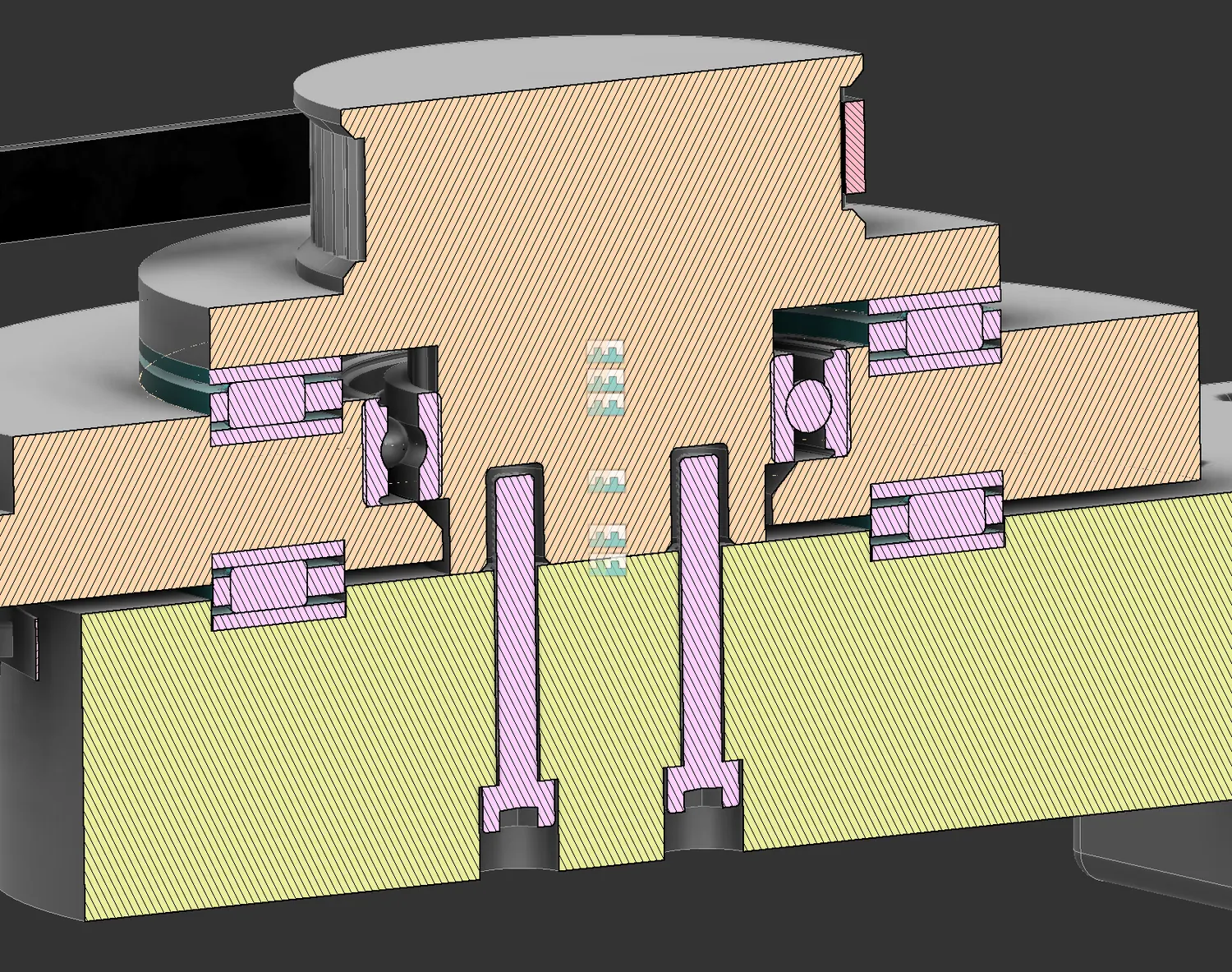
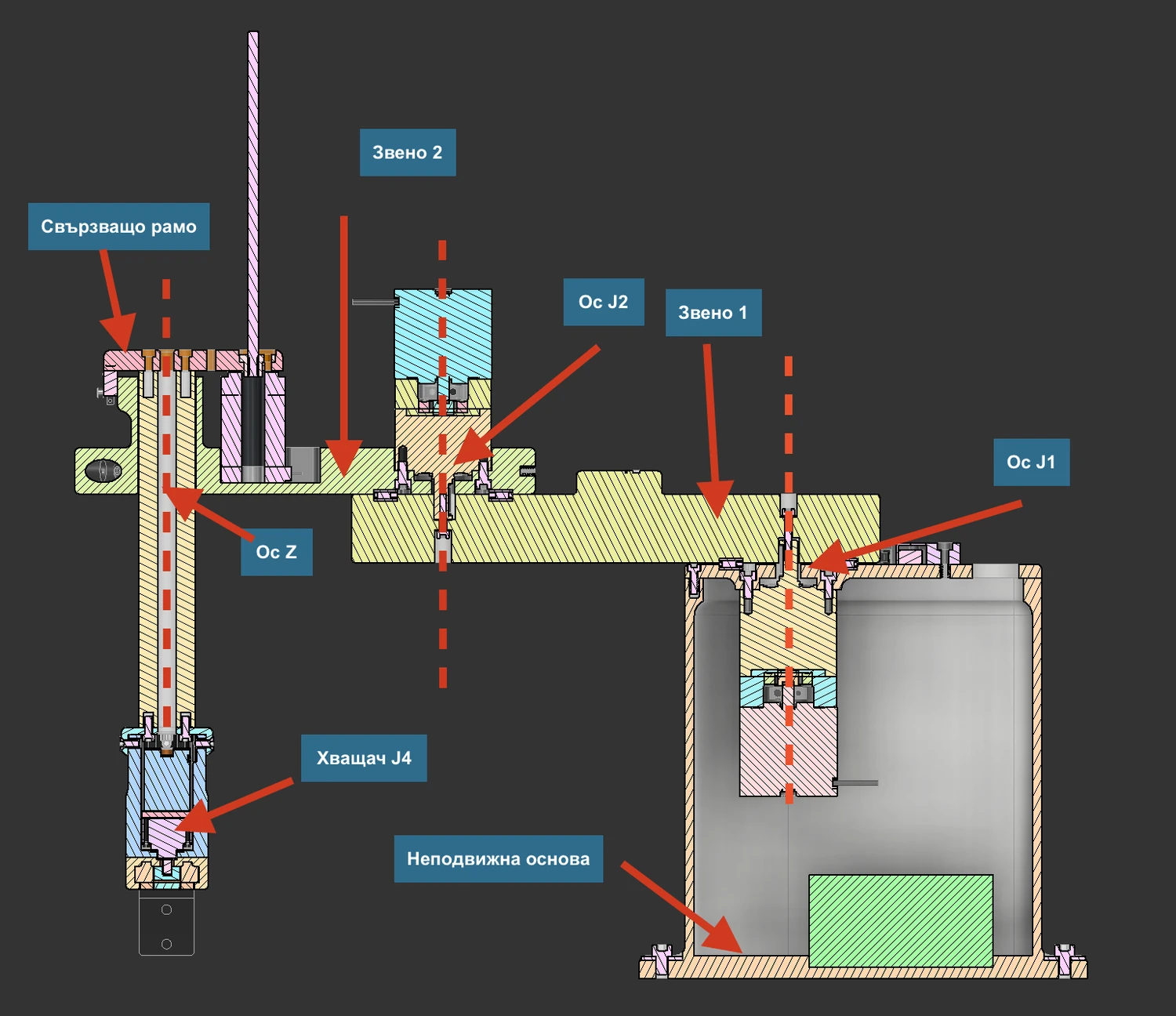
CAD section of the J1 bearing arrangement
J1 axial bearing arrangement
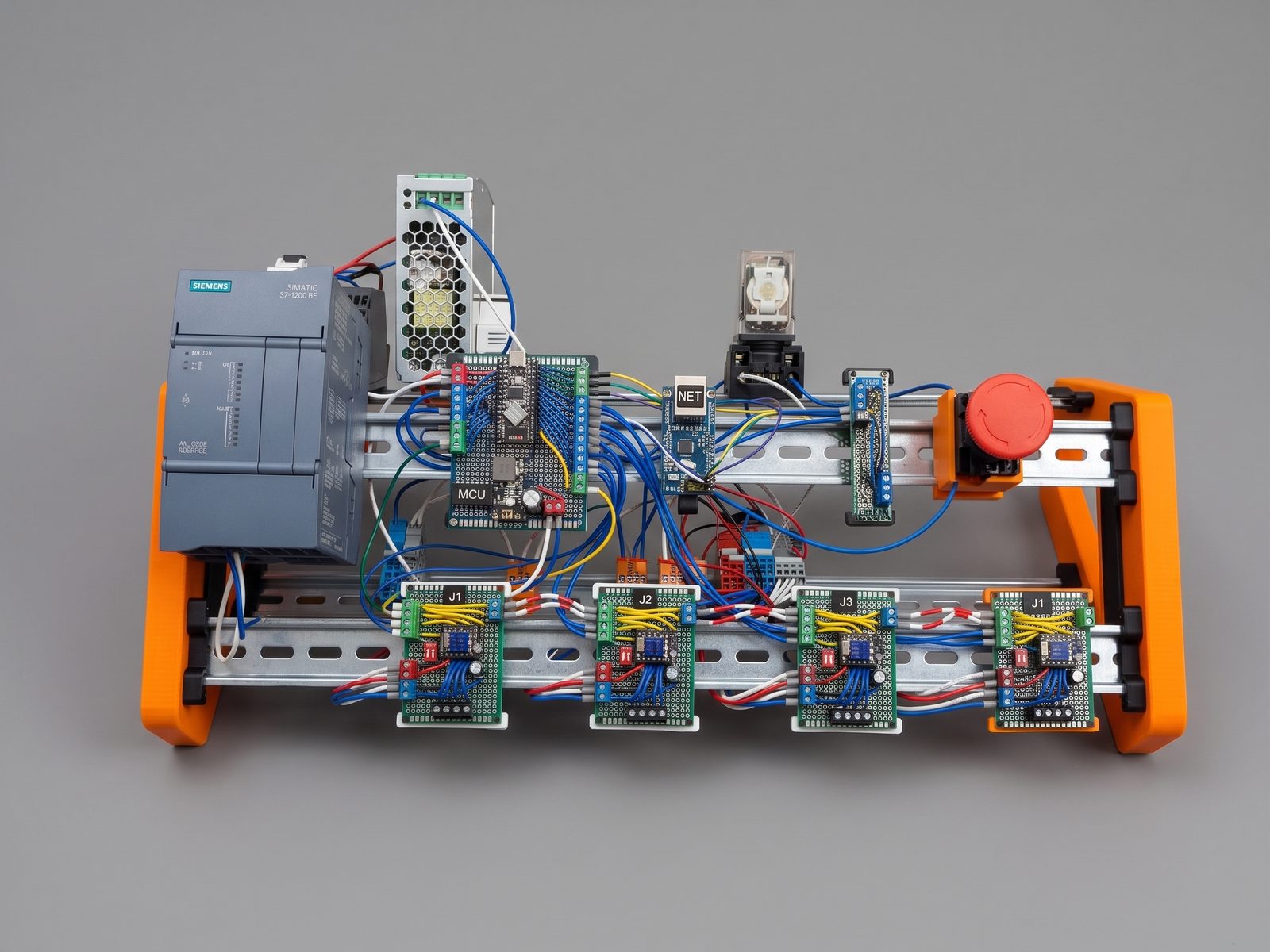
The control panel: Siemens S7-1200, power supply, MCU and four stepper driver boards on DIN rail
Control panel · S7-1200, drives, E-stop
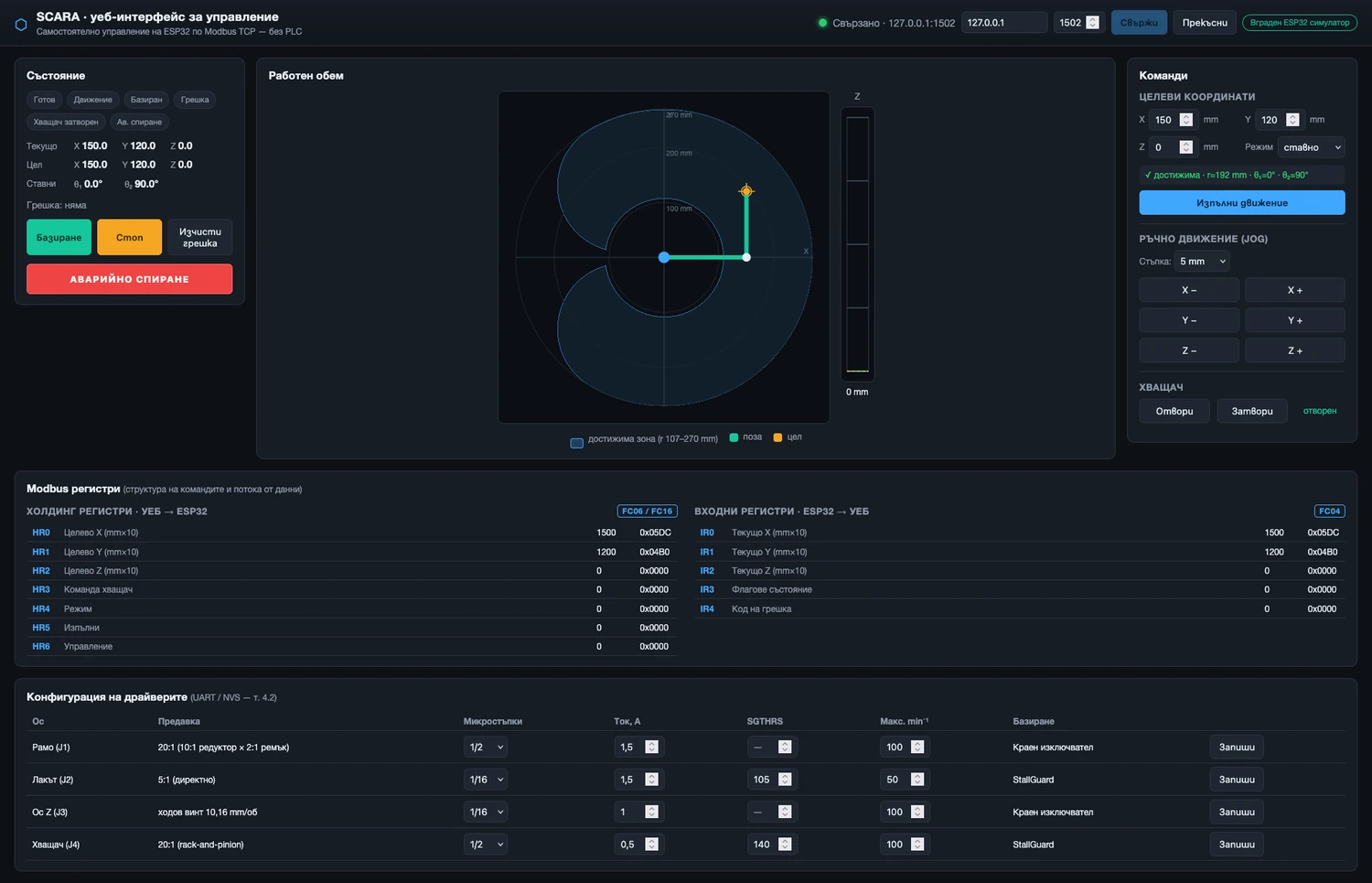
Embedded web control interface
Standalone web control interface

Project validation

Test results and limitations.

Results are separated into observed behavior, demonstrated load and calculated design targets. No analytical value is presented as laboratory certification.

Observed · 25 cycles

≈ 1–2 mm

Typical endpoint deviation

Caliper-based endpoint-return test with an approximately 100 g payload. Useful as a preliminary engineering check, but not a metrology-grade repeatability measurement.

Demonstrated in lab

≈ 230 g

Payload lifted

The highest conveniently available laboratory load was lifted without difficulty. XY deviation was not measured at this maximum tested load.

Design analysis

≈ 500 g

Calculated working payload

Derived from Z-axis force analysis with an engineering safety factor. This remains a design value until a controlled payload test is completed.

12 mm

Failure → diagnosis → fix

A gear slip exposed excessive motor current.

One early test produced a roughly 12 mm outlier after a gear slip. The current and control behavior were corrected in firmware, then the robot completed another multi-cycle run without the fault recurring. Mechanical backlash remains the next accuracy constraint.

Test campaign in progress

Controlled payload and repeatability matrix

A structured run at 0 g, 100 g and 230 g is underway: maximum deviation and cycle time per load, over a fixed cycle count. The numbers land here when the campaign closes. Nothing is estimated in the meantime.

Testing now

Planned improvements

Closed-loop position feedback.

The prototype proves the architecture. The next version should make position observable rather than assumed.

  • 01 Joint encoders for closed-loop position verification
  • 02 Reduced drivetrain backlash and stiffer joints
  • 03 Formal repeatability, payload and cycle-time test plan
  • 04 End-to-end PLC commissioning and fault recovery

Project repository

Source code and
project files

The CAD, the ESP32 firmware and the S7-1200 program are being cleaned up for public release, so everything on this page can be reproduced rather than taken on trust. The repository below is the working one; the full diploma document stays private until the academic embargo lifts.

Open GitHub More projects